


by Jeremy Kareken, David Murrell & Gordon Farrell
Based on the book by John D'Agata and Jim Fingal
Playhouse on Park, West Hartford, CT
April 15th through May 3rd 2026
Director: Matt Pfeiffer
Scenic Designer: Patti Panyakaew
Lighting Designer: Johann Fitzpatrick
Costume Designer: KT Farmer
Props Master: Judi Manfre
Production Stage Manager: Rebecca Donaghy
Sound Designer: Jeffrey Salerno
Cast:
Jim Fingal: Edward Montoya
Emily Penrose: Suzanne O'Donnell
John D'Agata: Shannon Michael Wamser
Program Link
Photo Credits: Meredith Longo
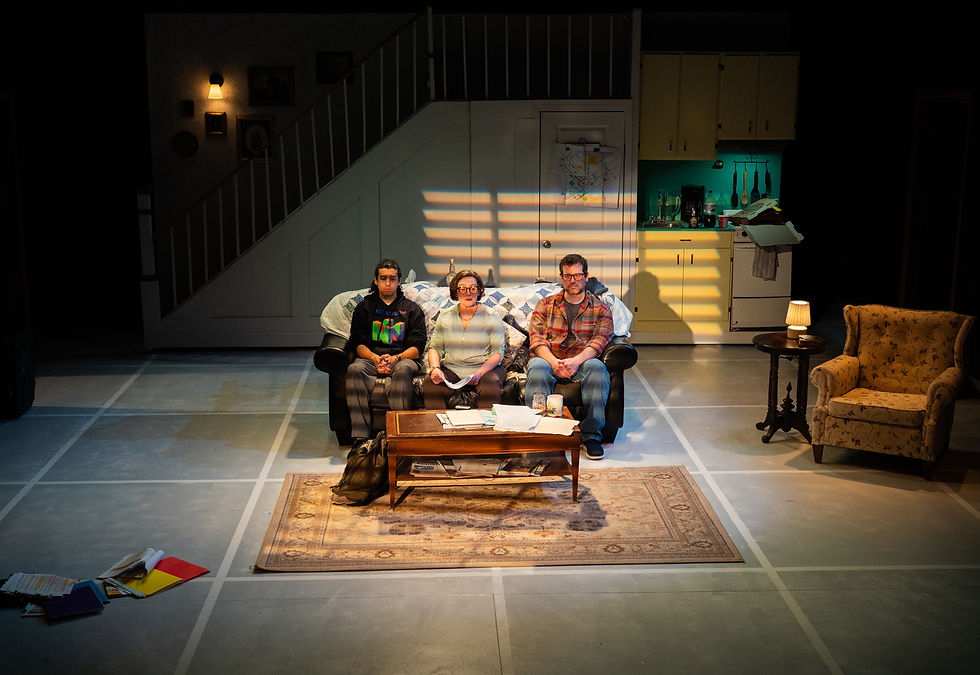
The Cast reads the essay out loud after a long night of arguing. Every time a sound is mentioned we hear a chord from the show's theme as well as a soft distant sound that is mentioned, casino rings, pool splashes, chain link rattling, a woman announcing, etc

Jim's emails are presented as voice overs that are said more professionally and with less commentary than the actor (Edward Montoya) presents live

Scene in Emily's (Suzanne O'Donnell) Office when she hires Jim (Edward Montoya). There is a flurry of emails and dings that come from Emily's devices within the scene.
The Cast reads the essay out loud after a long night of arguing. Every time a sound is mentioned we hear a chord from the show's theme as well as a soft distant sound that is mentioned, casino rings, pool splashes, chain link rattling, a woman announcing, etc
Reviews
"There is a distinctive sound design by Jeffrey Salerno that adds to the clean brisk style"
- Christopher Arnott, Hartford Courant
"Sound designer Jeffrey Salerno describes a process of creating a piece, built on “variations of the same simple melody,” reminiscent of the fast-paced, just shy of frantic environment of a New York magazine office. This geometric sound design, this sonic fractal, underscores the emotional storytelling beneath the actors' nuanced deliveries, adding layers of storytelling that beautifully complement the primary narrative." Kimolee Eryn Reviews
Summary
Lifespan of A Fact is the story of a writer, and a fact checker and how truth is told, through facts or art. Emily Penrose (Suzanne O'Donnell) is the Editor of a big magazine. She has an essay written by John D'Agata (Shannon Michael Wamser) that she is excited to publish about a young man who jumps off of a building in Las Vegas. It just needs a final fact check. Jim (Edward Montoya) is a young, eager fact checker who utilizes technology to grab every bit of information he can. This presents a problem when Jim discovers a few... well actually quite a lot of facts that are inaccurate. Everything from whether the bricks of a building were red or brown to a claiming a girl hung herself when she also jumped off a building. Emily can't be bothered to get into it with Jim so she shares John's contact information with him. Jim and John have a back and forth about whether the facts are accurate or if they sound right or not.
The show is about responsibility to tell the truth. What is a fact that helps express the truth or a fact that is used to cloud the deeper meaning.
Concept and Process
When Matt Pfeiffer and I first met to discuss Lifespan of A Fact and how to utilize Sound in the storytelling, he presented me with a challenge. In the original production, there is a heavy use of projections to show emails flying back and forth, location, time of day, and to display the essay that the story revolves around. In our production, because we were in a small three quarter thrust, it was decided that we would not use projections. And so Sound would be the primary design element communicating all of this information.
The Sound Design broke down into four parts: The Essay, The Emails, Transitions, and Diegetic Sounds.
The Essay:
Because we determined projections would not be used I had to come up with a way to communicate the text of the essay, which starts the show, in a way that isn't just listening to someone read the text. Because of the themes of the show I came up with the idea to compose a theme that built upon itself getting more and more complicated, but at its core was still simple. In mathematics and geometry there is a concept called fractals where if you look at any part of a larger whole it will still be the same shape. Like a piece of broccoli. I wanted to do that musically. I began with a simple melody that I manipulated by pitching it up and down, slowing it down and speeding it up and all of those eventually layered on top of each other.
The text of the essay was recorded to be a voice over. But when the text came in, that fractal pattern was too busy, so I took the underscore down to just chords in the same key. This chord progression became a repeated theme throughout the show, any time the essay was read.
In the final moments of the show, after arguing and going through all of the errors and why they NEED to be that way. Emily begins to read the essay and says "Let's try and see it. The slot machines. The card tables. Hear the sounds and see the lights of the casino. Read. Right here."
During this final reading of the essay, any time a sound is mentioned, the casino, kids running around, a pool splashing, a woman making an announcement, a couple taking pictures etc. The sound was played very quietly and distantly so the audience is hearing the essay with the characters. Each sound was accompanied by a chord from the essay's theme and a shotgun mic turned on above the actors with a reverb effect on. This gave the final moment a reverie about it. When the essay came to the moment about sitting in silence for 48 seconds, all the other sounds stopped. Because there was a bed of sound underneath the reading of the beginning of the essay, it added to the weight of this silence.
The samples below are of the Opening Sequence including the monologue performed by Shannon Michael Wamser (LOAF TOS Opening Monologue w US) and the underscoring for the final essay moment (LOAF 2026 FINAL Essay) the text of which was performed live by the cast. For the final essay each sound was a seperate cue taken by the operator as each sound was mentioned in the live reading.
The Emails:
For the emails, we recorded Voice Overs of the actors reading the text that would be originally projected. The sound played to speakers localized to where the actor was on stage. When the script indicated the actor saying something that varied from the email text, I separated the email voice over into several cues so the beginning could play, he would react and then the email would finish.
Transitions:
During the show there are several transitions that show change of time. To keep the pace of the script these had to be fairly tight but also needed to be long enough to cover stage business. I knew they had to be within the world that we had built but also had to be distinct from the Fractal motif. Because so much of the action of the show revolved around emails and notifications. I ended up pulling some of those dings and boops and turning them into short clips that would grow and warp until the stage manager could call them out. This gave us a flexible length of cue that could run if the stage business of setting props was taking longer than expected.
For the transition from NY to Las Vegas, we needed to cover about a minute of action where the walls of the stage turned around going from a manhattan Magazine office to a suburban living room. This also had to cover furniture moves and costume changes. Jim (Edward Motoya) begins by reading the text of the essay and we hear the chords underscoring him. As he makes the decision to go to Vegas, we hear the Fractal motif come in and the change begins in earnest. As we near the end of the set change the reverb for the Fractal grows and grows until it overtakes the articulated pattern. The scene starts with Emily answering the phone which takes us out of the transition.
Diegetic:
This was the easy part. Speakers were installed in places that allowed me to localize dings and email whooshes and rings and buzzes.